Regarding several dengue cases in Valledupar, Cesar, Colombia.
The Municipal Health Secretariat of Valledupar confirmed approximately 305 dengue cases up to epidemiological week 04 of 2026. In light of this situation, the health authority urges the population that, in case of presenting fever (temperature above 38.5 °C), joint pain, headache, or nausea, they should not self-medicate and should seek timely medical care.
But what is dengue? How is it transmitted? And what should we do if we suspect the disease? Here we explain it in a simple way.
What is dengue?
Dengue is a viral disease caused by a virus from the Flaviviridae family, belonging to the group of arboviruses (viruses transmitted by arthropods, mainly mosquitoes).
There are four serotypes of the virus: DENV-1, DENV-2, DENV-3, and DENV-4. A person can become infected up to four times throughout their lifetime.
Globally, it is estimated that approximately 3.9 billion people live in areas at risk. The most affected regions are the Americas, Southeast Asia, and the Western Pacific. Although dengue can occur endemically throughout the year in some countries, significant increases in cases are usually recorded every 3 to 5 years, which can lead to cyclical epidemics.
How is dengue transmitted?
The disease is transmitted through the bite of infected mosquitoes of the Aedes genus, mainly Aedes aegypti and, to a lesser extent, Aedes albopictus.
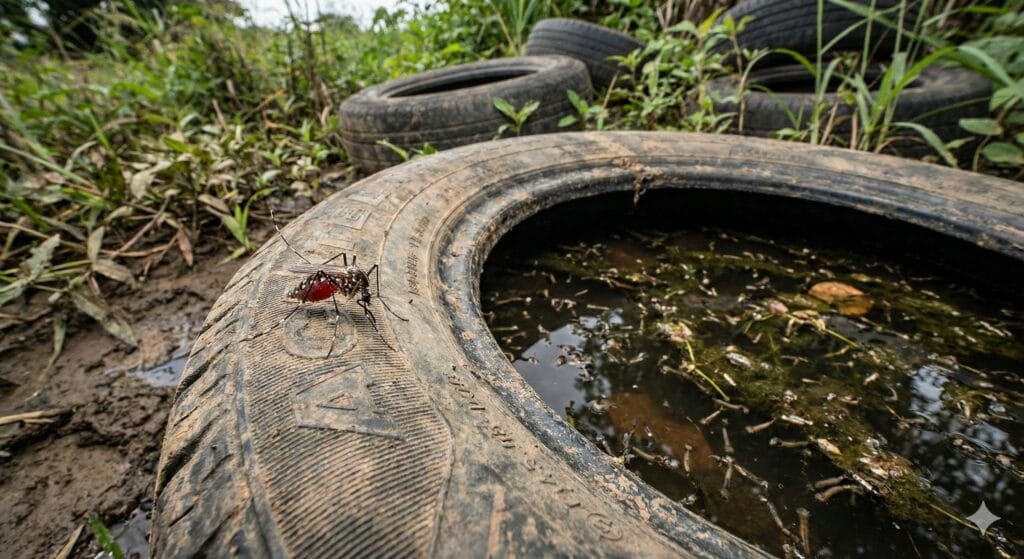
In Colombia, the most common vector is Aedes aegypti, a mosquito that lives near homes and breeds in clean, stored water found in containers such as tanks, buckets, flower vases, and tires.
The mosquito becomes infected when it bites a sick person and can later transmit the virus to other healthy individuals.
What are the symptoms of dengue?
The infection can range from asymptomatic cases to severe forms. The clinical presentation may vary depending on the patient’s age and health status.
In older children and adults, the disease usually presents as a febrile illness without warning signs.
The disease is characterized by:
- Sudden onset of high fever
- Severe headache
- Retro-orbital pain (pain behind the eyes)
- Myalgia (muscle pain)
- Arthralgia (joint pain)
- Skin rash
In some cases, it may progress to severe forms, with significant plasma leakage, hemorrhages, and organ involvement, which can lead to dengue shock if not managed promptly.
In school-aged children, hepatic and neurological manifestations have been more frequently described. Less commonly, renal, cardiac, and pulmonary complications may occur, as well as hemophagocytic syndrome, pancreatitis, and acute abdomen
It is important to be alert to warning signs such as severe and persistent abdominal pain, persistent vomiting, mucosal bleeding, drowsiness, or irritability
Is there a treatment for dengue?
Despite technological advances, there is no specific antiviral treatment for dengue. Management consists of supportive care measures, mainly adequate hydration (oral or intravenous) and close clinical monitoring while the body overcomes the infection.
For this reason, early detection and prevention remain the most important tools to reduce complications and mortality.
What should I do if I think I have dengue?
You should seek medical care immediately for a comprehensive evaluation. There are multiple diseases that can produce similar symptoms (such as fever and joint pain), so diagnosis and treatment must be determined exclusively by medical professionals.
It is essential to avoid self-medication, especially with nonsteroidal anti-inflammatory drugs (NSAIDs), as they may increase the risk of bleeding
What preventive measures are available?
Since the disease is transmitted through mosquito bites, the main preventive strategy is the control of breeding sites. This includes:
- Eliminating containers that collect water
- Properly washing and covering tanks and water storage containers
- Frequently changing the water in flower vases and animal drinking containers
- Properly disposing of tires and unused objects
- Allowing fumigation activities when indicated by health authorities
At the individual level, it is recommended to:
- Wear long-sleeved clothing
- Apply repellent according to instructions
- Sleep under mosquito nets
- Install screens or mesh on doors and windows
Eliminating breeding sites inside homes is one of the most effective measures to reduce transmission.
Links of interest
https://www.ins.gov.co/buscador-eventos/Lineamientos/Pro_Dengue.pdf
Author
Gerhard M Acero
ESP epidemiologist
Publication date: 13/02/2026
This post has not been sponsored.